Blackjack Online Casino NZ 2026 — Play Real Money Blackjack for Kiwi Players
Blackjack is the only casino game where the decisions you make genuinely change the expected outcome. Every other game in the casino — roulette, pokies, baccarat — plays out the same way whether you understand the mathematics or not. Blackjack is different. A player who has learned basic strategy will face a house edge of approximately 0.4% to 0.6%. A player playing by feel will face an edge of 2% to 4%. That gap is not marginal. Over a meaningful number of hands, it determines whether blackjack is among the most player-favourable games in the casino or merely an average one.
This is why blackjack attracts a different kind of NZ casino player — one who is interested not just in the outcome of each hand, but in making the right decision on every hand. The card counter who reduced the house edge to zero at physical casinos made the strategy legend. Online blackjack in New Zealand in 2026 brings that same decision-based game to every device in the country, with more variants, more stake flexibility, and more access to live dealer tables than any physical casino in New Zealand has ever provided.
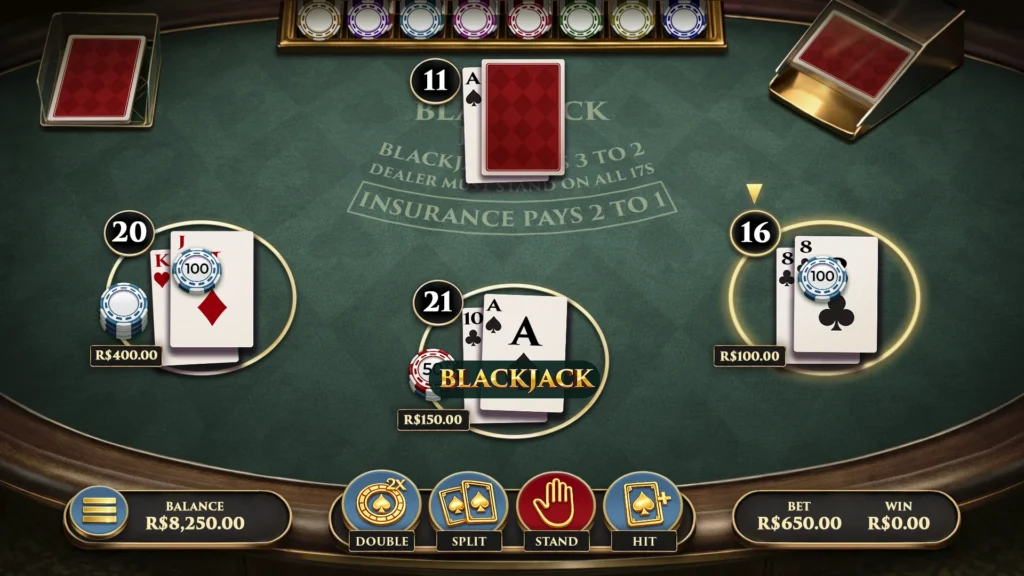
Why Blackjack Has the Best Odds in the Casino
The numbers are worth stating clearly before anything else.
With basic strategy applied consistently, single-deck blackjack against the most favourable dealer rules carries a house edge of approximately 0.13%. Standard six-deck blackjack with optimal rules and perfect basic strategy runs at approximately 0.40% to 0.60%. No table game at any NZ online casino — including baccarat at 1.06% on the banker bet and French Roulette at 1.35% on even-money bets — matches blackjack when strategy is applied correctly.
The critical qualifier is basic strategy. Without it, the house edge climbs toward 2%, 3%, or higher depending on the quality of decisions made. The gap between the best and worst blackjack players in expected value terms is larger than the gap between any two players at a roulette or baccarat table, because those games eliminate player decision-making entirely.
This is simultaneously blackjack’s greatest advantage and its primary challenge. The game rewards preparation. Players who invest thirty minutes learning basic strategy before their first real money session will play a materially different — and materially better — game than those who rely on intuition.
Basic Strategy — The Foundation of Every Blackjack Decision
Basic strategy is a mathematically derived decision framework that specifies the optimal play for every possible combination of player hand and dealer upcard. It was developed in the 1950s through computer simulation of millions of blackjack hands and has been refined repeatedly as computing power has increased.
The strategy is not intuitive in every case. Many of its recommendations contradict what feels correct. Standing on 16 against a dealer’s 7 feels wrong — the hand looks weak and you want to hit. Basic strategy says hit because the probability of improving the hand outweighs the risk of busting, given the dealer’s likely strong final total with a 7 showing. Following the strategy consistently requires trusting the mathematics rather than the instinct.
The most important basic strategy decisions cover several key areas.
When to Hit and When to Stand
On hard totals — hands without an ace counted as 11 — the fundamental rule is to stand when the dealer shows a weak upcard of 2 through 6, and to hit when the dealer shows a strong upcard of 7 through ace. The rationale is that a dealer showing 2 through 6 has a high probability of busting, so the correct strategy is to avoid busting yourself and let the dealer do the work. A dealer showing 7 through ace is likely to make a strong hand, so you need to improve your own hand to compete.
Hard 17 or above: always stand regardless of dealer upcard. Hard 13 through 16: stand against dealer 2 through 6, hit against dealer 7 through ace. Hard 12: stand against dealer 4 through 6, hit against everything else. Hard 11: double down against dealer 2 through 10, hit against dealer ace. Hard 10: double down against dealer 2 through 9. Hard 9: double down against dealer 3 through 6, hit against everything else.
Soft Hands — Aces Change Everything
A soft hand contains an ace counted as 11. Soft hands cannot bust on a single hit because the ace reverts to a value of 1 if the total would exceed 21. This fundamentally changes the strategy.
Soft 19 (ace and 8): always stand — the total is too strong to risk. Soft 18 (ace and 7): double down against dealer 2 through 6, stand against dealer 7 and 8, hit against dealer 9 through ace. Soft 17 (ace and 6) and below: always hit or double down — never stand on a soft total of 17 or below regardless of the dealer’s upcard, because the ace protection means no bust risk on a single additional card.
Splitting Pairs
Pair splitting is one of the most misunderstood areas of blackjack basic strategy, and getting it wrong costs players significant expected value.
Always split aces and eights. Aces: splitting gives two chances at a hand starting with 11, the strongest starting position in blackjack. Eights: a hard 16 is the worst hand in blackjack — splitting converts it into two hands each starting from 8, a vastly superior position. Never split fives or tens. A pair of fives is a hard 10 — one of the strongest doubling hands. A pair of tens totals 20 — the second-best hand in blackjack. Splitting either wastes the advantage.
Nines: split against dealer 2 through 6 and 8 through 9, stand against dealer 7, 10, and ace. Sevens: split against dealer 2 through 7. Sixes: split against dealer 2 through 6. Fours: split against dealer 5 and 6 only. Threes and twos: split against dealer 2 through 7.
Doubling Down
Doubling down adds a second bet equal to the original stake in exchange for receiving exactly one additional card. It is the primary mechanism through which skilled blackjack players build their mathematical advantage.
The optimal doubling situations follow the pattern: double when the expected value of your hand with one additional card exceeds the expected value of hitting and potentially receiving multiple cards. Hard 11 against any dealer upcard except ace is the clearest doubling situation — the probability of hitting 21 with one card and the strength of the total even without it make doubling the dominant play. Hard 10 against dealer 2 through 9, and hard 9 against dealer 3 through 6, are the other primary doubling situations.
Soft hand doubling — particularly soft 13 through 18 against dealer 4 through 6 — is less intuitive but equally important. Against a dealer showing a weak 5 or 6 with very high bust probability, doubling any soft hand from soft 13 upward captures maximum value from the dealer’s vulnerability.
Blackjack Rules That Affect the House Edge
Not all blackjack games are created equal. The specific rules in effect at any given blackjack table directly affect the house edge, and knowing which rules matter allows NZ players to identify the most player-favourable tables in any casino’s blackjack lobby.
The Blackjack Payout — The Single Most Important Rule
Blackjack — a natural 21 from the first two cards, consisting of an ace and a ten-value card — should pay 3 to 2. This means a $10 blackjack bet wins $15. Games that pay 6 to 5 on blackjack instead of 3 to 2 add approximately 1.39% to the house edge. This is a massive change that transforms a player-favourable blackjack variant into a significantly worse game than most other casino options.
Always confirm the blackjack payout before sitting at any table. 3 to 2 is standard and correct. 6 to 5 is exploitative and should be avoided entirely. If the table pays 6 to 5, leave.
Number of Decks
Single-deck blackjack carries the lowest house edge — approximately 0.15% with optimal rules and perfect strategy. Every additional deck adds a small increment to the house edge because the composition of the remaining deck becomes less predictable and the advantage of natural blackjacks is slightly diluted. Six-deck and eight-deck shoes — the most common configuration at NZ online casinos — carry house edges of approximately 0.40% to 0.65% with optimal rules and perfect strategy.
Dealer Hits or Stands on Soft 17
A dealer who stands on all 17s — including soft 17 — gives the player a slight advantage relative to a dealer who hits soft 17. Hitting soft 17 adds approximately 0.22% to the house edge. Tables marked H17 (hit soft 17) are slightly less favourable than those marked S17 (stand on soft 17). When both are available, choose S17.
Doubling Restrictions
Some tables restrict doubling to hard totals of 9, 10, and 11 only. This eliminates the soft hand doubling opportunities that basic strategy exploits against weak dealer upcards. No doubling restrictions — the ability to double on any first two cards — is the more player-favourable rule and reduces the house edge by approximately 0.25% compared to a 9-10-11 only doubling restriction.
Splitting and Re-splitting
The ability to re-split pairs — splitting a second time if the split hand produces another matching pair — is a player-favourable rule that reduces the house edge slightly. Being allowed to draw multiple cards to split aces, rather than receiving only one card per ace after splitting, is similarly player-favourable. Not all tables offer these options — check before playing.
Surrender
Late surrender — the ability to surrender your hand and recover half your bet after the dealer checks for blackjack — is one of the most player-favourable optional rules available. It is particularly valuable on hard 15 and 16 against dealer 9, 10, and ace — precisely the worst starting positions in blackjack where the probability of losing the hand is highest. Games offering late surrender reduce the house edge by approximately 0.07% to 0.09%.
Online Blackjack Variants at NZ Casinos
Classic Blackjack
Classic Blackjack uses standard rules — typically six or eight decks, 3 to 2 natural payout, double on any two cards, split up to three times, no re-splitting aces. It is the baseline format against which all other variants are measured and the most widely available format at NZ online casinos in both RNG and live dealer versions.
European Blackjack
European Blackjack uses two decks and introduces a significant rule difference from the American version — the dealer does not receive a hole card until after all player actions are complete. In standard American blackjack, the dealer checks for blackjack at the start of the hand if showing an ace or ten, and the hand ends immediately if the dealer has blackjack. In European Blackjack, the dealer’s second card is not dealt until the player has acted, meaning players can lose doubled and split bets against a dealer blackjack.
This no-hole-card rule adds approximately 0.11% to the house edge of European Blackjack. The two-deck shoe partially compensates for this, and the overall house edge of European Blackjack with perfect strategy is competitive with standard multi-deck American variants.
Multihand Blackjack
Multihand Blackjack allows players to play two, three, four, or five simultaneous hands in a single round, each with its own bet and its own sequence of player decisions. The house edge per hand is identical to single-hand blackjack under the same rules — what changes is the variance and the session pace.
Playing five simultaneous hands at $2 per hand generates the same wagering volume as playing one hand at $10 per hand, but with significantly more interaction and decision-making per round. For NZ players who find single-hand blackjack too slow for their preferred session pace, Multihand is the natural solution — more decisions per minute, more engagement per round, same expected value per dollar wagered.
Blackjack Switch
Blackjack Switch deals two simultaneous hands and gives the player the unique option to swap the top cards between the two hands before playing either. This rule dramatically increases the player’s ability to construct strong starting hands and, used optimally, produces some of the most favourable starting positions available in any blackjack variant.
The trade-off is a set of compensating rules that restore the house edge: dealer 22 pushes rather than busting, blackjack pays even money rather than 3 to 2, and a Super Match side bet offers payouts based on the four starting cards. The house edge on Blackjack Switch with optimal strategy is approximately 0.58% — competitive with standard multi-deck blackjack, but only when the switching strategy is applied correctly.
Infinite Blackjack
Infinite Blackjack is a live dealer format from Evolution Gaming that removes the traditional seat limit — any number of players can join the same table simultaneously. All players receive the same community hand and make independent decisions on what to do with it.
The format solves the practical problem of full live blackjack tables where players have to wait for a seat. Since everyone shares the same hand dealt by the dealer, there is no seat count limit. The house edge is comparable to standard six-deck blackjack under the same rules.
Lightning Blackjack
Lightning Blackjack from Evolution Gaming applies a similar multiplier mechanic to the one used in Lightning Roulette. Before each round, one to three cards are assigned random multipliers of 2x to 25x. If those cards feature in a player’s winning hand, the payout is multiplied accordingly. The trade-off is that the base 3 to 2 blackjack payout is replaced with even money — the multipliers are funded by this reduction in the standard payout. House edge with optimal strategy is approximately 0.54%.
Free Bet Blackjack
Free Bet Blackjack from Evolution Gaming provides complimentary double downs and splits on qualifying hands — doubles are free on hard 9, 10, and 11, and splits are free on pairs except tens. The free bets are funded by the casino rather than the player. The compensating rule is that dealer 22 pushes rather than busts. House edge with optimal strategy is approximately 1.04% — higher than standard blackjack, but the free doubling and splitting significantly extends session length and the entertainment of constructing advantageous positions without additional stake risk.
Live Dealer Blackjack at NZ Online Casinos
Live dealer blackjack is the most popular live casino game category at NZ online casinos and represents the closest digital equivalent of sitting at a physical casino blackjack table.
Professional dealers operate from purpose-built studios using actual physical cards and standard casino equipment. High-definition cameras capture multiple angles of every hand. Optical Character Recognition technology reads card values in real time and populates the digital interface with the current hand information. NZ players interact with the game through a betting interface alongside the live video feed, making decisions the same way they would at a physical table — Hit, Stand, Double, Split, Surrender where available.
The quality of the live blackjack experience at leading NZ casino platforms is genuinely impressive. Dealers are trained professionals with strong English communication skills. Stream quality is consistently 1080p HD under standard NZ broadband and 4G connections. Round pace at standard tables is approximately 40 to 60 hands per hour — significantly slower than RNG blackjack but providing the authentic table atmosphere that many NZ players specifically seek.
Luckyvibe Casino and Vegas Now carry the most comprehensive live blackjack lobbies available to NZ players, including Evolution Gaming’s full range of standard and variant live blackjack tables across multiple stake levels. Standard live tables typically carry minimums of $1 to $5 per hand. VIP and high-limit tables carry minimums of $25 to $100 with maximums reaching into the tens of thousands for players operating at premium stake levels.
RNG Blackjack vs Live Dealer — Choosing the Right Format
Both formats play by the same rules, carry the same house edge under identical rule sets, and produce the same long-run mathematical expectations. The choice between them is about playing experience rather than mathematics.
RNG blackjack suits players who want maximum hand rate — the ability to play 200 or 300 hands per hour rather than the 40 to 60 at a live table. Players who are actively practising basic strategy, building familiarity with specific rule sets, or who enjoy rapid-fire gameplay without the social element of a live dealer will prefer the RNG format.
Live dealer blackjack suits players who want the atmosphere of a real casino table, the visual confirmation that the cards are being dealt from a real shoe by a real person, and the social interaction of a live dealer environment. It is slower but richer in experiential terms, and for many NZ players the live format is the primary appeal of online casino blackjack compared to the pokies and other games available.
For players who are new to blackjack, starting with RNG demo play — using the free play version available at most NZ casinos — allows strategy practice without any financial pressure, at any pace, with the ability to pause and consult a basic strategy chart between decisions. Progressing to RNG real money play, then to live dealer, is the most natural learning progression.
Card Counting — What It Is, What It Is Not, and Why Online Blackjack Changes Everything
Card counting is the most famous advantage play technique in casino history. It involves tracking the ratio of high to low cards remaining in the shoe to identify moments when the composition of the remaining deck favours the player, then increasing bets during those favourable periods.
Card counting is not illegal. It is a mental skill — using publicly available information from the dealt cards to inform betting decisions. Physical casinos deal with card counters by shuffling frequently, using multiple decks, and asking identified counters to leave. It is a cat-and-mouse game that has defined the relationship between skilled players and casinos for sixty years.
Online RNG blackjack is immune to card counting because the virtual shoe is reshuffled after every hand. There is no remaining deck composition to track — every hand starts from a fully randomised deck. The card counter’s advantage is entirely eliminated in the RNG format.
Live dealer online blackjack is theoretically susceptible to card counting but practically very difficult to execute effectively. Live tables use continuous shuffling machines at many NZ casinos, which eliminate the remaining deck composition advantage entirely. Tables that use a standard shoe typically cut a significant portion of the remaining cards before the shuffle point is reached, reducing the penetration available to the counter. Combined with the practical difficulty of tracking cards while managing a digital betting interface on a screen rather than physically at a table, card counting advantage at online live blackjack is marginal at best.
For the vast majority of NZ blackjack players, card counting is a curiosity rather than a practical strategy. The return from mastering basic strategy — moving from a 2% house edge to 0.5% — is achievable by any player willing to invest an hour of study. The additional return from card counting on top of perfect basic strategy is small, requires significant mental effort to execute correctly, and is largely negated by continuous shuffling at online live tables.
Free Blackjack Play at NZ Online Casinos
Demo mode blackjack — free play with virtual credits — is available at virtually every NZ online casino without registration or deposit. The game plays identically to the real money version in terms of rules, mechanics, and decision structure. The only difference is that wins and losses affect a virtual balance with no real-world value.
For NZ players learning blackjack, free play is invaluable. It allows basic strategy practice in a real game environment without financial pressure, the ability to pause between decisions to check a strategy chart, exploration of different variant rules to understand how they affect gameplay, and assessment of the casino’s game interface and functionality before committing real money.
The limitation of free play blackjack is the absence of financial stakes, which changes the decision-making psychology in ways that matter. Many blackjack decisions — particularly the counterintuitive ones like hitting 16 against a dealer’s 7, or doubling soft 18 against a dealer’s 5 — feel different when real money is involved. Practising in demo mode builds knowledge. The first real money session tests whether that knowledge holds under actual financial pressure.
Responsible Play at Online Blackjack
Blackjack’s low house edge is sometimes cited as a reason it is a safer game than higher-edge alternatives. This is partially true — a lower house edge does mean less expected loss per dollar wagered over time. But the fast pace of online blackjack, particularly in RNG format where 200 or more hands per hour is easily achievable, means total wagering volume per session can be very high even at low stakes.
A $1 per hand RNG blackjack session at 200 hands per hour generates $200 in wagering per hour. Against a 0.5% house edge, expected losses are $1 per hour — extraordinarily affordable. But if the session runs at $5 per hand at 200 hands per hour, total wagering is $1,000 per hour. Expected losses at 0.5% house edge are still only $5 per hour, but variance around that expected value is significant, and a losing session can produce outcomes well above the expected loss.
Setting a session time limit before opening a blackjack game is the single most effective responsible gambling practice for RNG blackjack players specifically, because the fast pace of the format makes it easy to lose track of how long a session has been running and how much has been wagered in total. All the licensed NZ casinos serving Kiwi players provide session time limit tools in their account settings.
The Gambling Helpline is available 24 hours a day at 0800 654 655 for NZ players who feel that gambling may be having a negative effect on their wellbeing.
Online Blackjack NZ — FAQs
What is the best online casino for blackjack in NZ? Luckyvibe Casino and Vegas Now are our top-rated platforms for NZ blackjack players, offering the most comprehensive live dealer blackjack lobbies from Evolution Gaming alongside strong RNG blackjack libraries across multiple variants and stake levels.
What is the house edge at online blackjack? With perfect basic strategy, the house edge at standard six-deck blackjack with favourable rules is approximately 0.40% to 0.60%. Without basic strategy, the house edge typically rises to 2% to 4% depending on the quality of play. This is the most strategy-responsive house edge of any standard casino game.
Can I play blackjack online for real money in NZ? Yes. All the NZ online casino platforms covered on this site accept NZD deposits and offer real money blackjack in both RNG and live dealer formats. Online blackjack for real money in New Zealand is fully accessible through the offshore-licensed casino platforms available to Kiwi players.
What is basic strategy in blackjack? Basic strategy is a mathematically derived set of decisions specifying the optimal play for every combination of player hand and dealer upcard. Developed through computer simulation of millions of blackjack hands, it minimises the house edge to approximately 0.5% when applied consistently. Basic strategy charts are freely available online and legal to reference — at a physical casino you may be asked not to use a physical chart at the table, but online there is no such restriction.
Should I always split aces in online blackjack? Yes. Splitting aces is always the correct play in basic strategy — splitting converts a starting total of 2 (or 12 if the other ace is counted as 1) into two hands each starting from 11, the strongest starting position in blackjack.
What does 3 to 2 vs 6 to 5 mean in blackjack? These figures refer to the payout on a natural blackjack — an ace and a ten-value card on the first two cards. At 3 to 2, a $10 blackjack bet wins $15. At 6 to 5, the same bet wins only $12. The 6 to 5 payout adds approximately 1.39% to the house edge and should be avoided entirely when 3 to 2 tables are available.
Can I use a strategy chart while playing online blackjack? Yes. There is no restriction on referencing a basic strategy chart while playing online blackjack at NZ casino platforms. Keeping a chart open in a browser tab or printed nearby is a completely acceptable approach for players who are still building familiarity with the optimal decisions.
What is the difference between RNG blackjack and live dealer blackjack? RNG blackjack uses certified Random Number Generator software to simulate card dealing, plays instantly at any pace, typically allows much lower minimum bets, and reshuffles after every hand. Live dealer blackjack streams a real human dealer dealing real cards from a real shoe, plays at approximately 40 to 60 hands per hour, provides the atmosphere of a real casino table, and is susceptible in theory to card composition tracking though largely negated by continuous shuffling at most online tables.
Is card counting possible at NZ online blackjack casinos? Card counting is not viable at RNG online blackjack because the deck is reshuffled after every hand. At live dealer tables, continuous shuffling machines are widely used, and where standard shoes are used the pen depth is typically insufficient for meaningful counting advantage. Card counting at online live blackjack tables available to NZ players provides marginal if any practical advantage.
What blackjack variant has the best odds? Single-deck blackjack with 3 to 2 natural payout, dealer stands on soft 17, double on any two cards, and late surrender available carries the lowest house edge of any standard blackjack variant — approximately 0.13% with perfect strategy. Among the variants commonly available at NZ online casinos, Classic six-deck blackjack with S17, 3 to 2, and double on any two cards offers the most player-favourable baseline.
The Game Worth Learning
Blackjack is unique in the casino in one specific way that this entire guide has been building toward — it rewards effort. Not luck. Effort.
The thirty minutes spent learning basic strategy before a first real money session changes the house edge from 2% to 0.5%. That is a genuine, measurable, permanent improvement in expected outcomes for every session after the study is done. No other casino game offers that return on that investment.
The NZ player who sits down at a 3 to 2 six-deck blackjack table with a basic strategy chart mentally accessible and $50 to play with is operating under one of the lowest house edges available anywhere in online gambling. The NZ player who sits at the same table playing by intuition is facing a house edge three to five times larger for identical stake risk.
The decision of which player to be takes thirty minutes to make. The return on that thirty minutes lasts for every blackjack session you ever play.
Gamble responsibly. The Gambling Helpline is available 24 hours a day at 0800 654 655.